Automotive Active Safety System Market Research: 2035
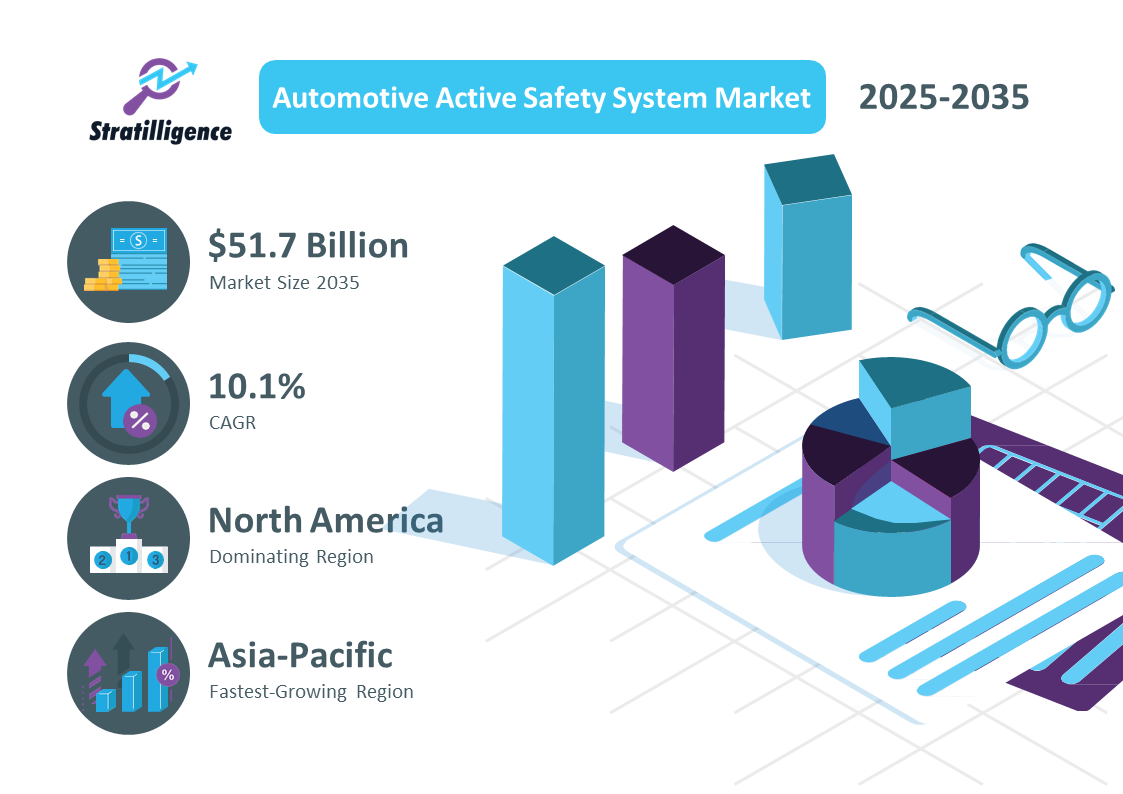
Rapid advancements in vehicle safety technology, stricter regulations, and rising consumer demand for safer driving experiences are driving the global automotive active safety system market, which was valued at $16.6 billion in 2024 and is expected to reach $51.7 billion in 2035 at a CAGR of 10.1%. A group of technologies known as “active safety systems” is designed to identify, alert, or stop accidents before they happen.
Active safety systems are intended to prevent or lessen collisions, in contrast to passive safety features like seatbelts and airbags, which only react after a collision. Adaptive cruise control (ACC), lane departure warning (LDW), automatic emergency braking (AEB), blind spot detection (BSD), electronic stability control (ESC), and night vision systems are some of the important systems in this category.
From luxury to mass-market models, automakers all over the world are progressively incorporating these technologies into their vehicles. These systems’ development has also been sped up by the incorporation of AI, radar, LiDAR, and camera-based sensors, which have increased their accuracy and dependability. Governments in North America and Europe, for example, have played a significant role in requiring or promoting the use of specific active safety features, which has further fueled automotive active safety system market expansion.
At the same time, increasing rates of traffic accidents, particularly in developing nations, are forcing policymakers and consumers to place a higher priority on safety. Broader trends like the growth of electric and driverless cars, advancements in sensor fusion and connectivity, and rising R&D expenditures by automakers and Tier 1 suppliers all contribute to the market’s expansion.
Key Market Drivers and Growth Factors in the Automotive Active Safety System Market
The market for automotive active safety systems is expanding globally as a result of the ideal fusion of new technology, changing consumer preferences, and regulatory requirements. As more governments enforce safety regulations, system adoption will be greatly accelerated. For example, the U.S. National Highway Traffic Safety Administration (NHTSA) will mandate that all new light vehicles sold by September 2029 have automatic emergency braking (AEB) that can prevent collisions up to 62 mph.
While Australia and India are developing their regulatory frameworks, Europe and Japan have already required advanced AEB features in new cars since 2022. By ensuring that ADAS features like adaptive cruise control, lane-keeping assistance, and blind-spot monitoring are widely included, these programs successfully increase the automotive active safety system market penetration.
Since studies have shown that active safety systems can reduce rear-end collisions by up to 50% and related injuries by 56%, consumer awareness of crash-avoidance systems has increased. Customer demand is fueled by this increased sense of safety, which leads OEMs to differentiate their models by including cutting-edge safety packages as standard. Additionally, as ADAS systems are the fundamental foundation of connected cars and self-driving platforms, the growing trend toward electrification and autonomous driving is promoting ADAS integration.
Coverage of the report
| Scope |
Details |
| Market Size Estimation |
Quantitative Insights: Market size and projections from 2021 to 2035, Market Size Units: USD Billion |
| Market Dynamics |
Analysis of drivers, restraints, and trends shaping the market |
| Industry Analysis |
Value chain analysis, Profit margin analysis, and Industry Overview |
| Segmentation |
By Product Type (Driver Monitoring System, Adaptive Cruise Control (ACC), Lane Departure Warning (LDW), Automatic Emergency Braking (AEB), Blind Spot Detection (BSD), Electronic Stability Control (ESC), and others), By Vehicle Type (Passenger Cars, Light Commercial Vehicles (LCVs), Heavy Commercial Vehicles (HCVs), and Off-highway vehicles), and By Propulsion Type (electric vehicles (EVs) and internal Combustion Engine (ICE) Vehicles)
|
| Region Insights |
Detailed analysis for North America, Europe, Asia-Pacific, Latin America, and MEA with key countries in each region |
| Competitive Analysis |
Company profiles, Ranking/Market share analysis, Competitive structure, Product differentiation |
| Customer Landscape Analysis |
In-depth understanding of the customer industry, preferences, and buying patterns |
| Supplier Analysis |
Comprehensive analysis of suppliers |
Key Benefits for Stakeholders
This comprehensive report provides stakeholders with in-depth qualitative and quantitative analyses, focusing on the global automotive active safety system market from 2024 to 2035.
Key benefits include:
- Insightful Automotive Active Safety System Market Forecast: The report offers detailed projections, covering various segments, current automotive active safety system market trends, and dynamics.
- Competitive Analysis with Porter’s Five Forces: A thorough examination of the bargaining power of buyers and suppliers, the threat of new entrants, competitive rivalry, and substitute products.
- Comprehensive Automotive Active Safety System Market Outlook Overview: Gain access to crucial information about key market drivers, restraints, and opportunities.
- Regional and Country-Level Mapping: The report maps out major regions and countries based on their revenue contribution to the global automotive active safety system market opportunity.
- Market Player Positioning: The competitive landscape analysis provides a clear understanding of the current market positioning of key players in the global automotive active safety system industry.
Key Restraints in the Automotive Active Safety System Market
Even with robust tailwinds, market expansion is difficult. Adoption is impeded by the high upfront costs associated with creating and integrating sensor arrays, such as LiDAR, radar, cameras, and specialized ECUs, particularly for low-cost and budget vehicle segments. Additionally, concerns about data privacy and cybersecurity are being examined more closely, as cars are turning into digital endpoints that can be compromised.
This raises the cost and complexity of the system overall and necessitates more software protections and compliance. False positives in AEB systems, or “phantom braking,” and excessively cautious emergency braking that might startle drivers or result in needless stops are issues that some regulators and consumer organizations are worried about.
Major automakers’ continuous legal resistance exacerbates these problems. Citing technological impracticability and regulatory overreach, the Alliance for Automotive Innovation, which represents industry titans like GM, Toyota, and Ford, filed a lawsuit contesting the AEB mandate in early 2025. Industry stakeholders may experience uncertainty as a result of this dispute, which could postpone or alter implementation.
Technological Advancements in the Automotive Active Safety System Market
Sensor Fusion & AI Algorithms
To give a more accurate real-time image of their surroundings, modern cars are depending more and more on sensor fusion, which combines information from lidar, radar, ultrasonic sensors, and cameras. When coupled with sophisticated AI/machine learning algorithms, this makes it possible for systems to identify cyclists, pedestrians, and even small animals more precisely. To increase system robustness, industry titans Bosch, Continental, and Autoliv have made significant investments in this fusion approach.
V2X & Connectivity Integration
By allowing vehicles to receive situational alerts beyond their line of sight, such as traffic stoppages or road hazards, communication technologies like 5G and V2X (vehicle-to-everything) improve active safety. New research, like 5G-connected ACC testbeds, demonstrates increased safety and comfort in hectic situations. Furthermore, manufacturers can continuously improve system performance after a sale by using over-the-air (OTA) software updates.
Enhanced Braking Protocols & Standards Compliance
In addition to emphasizing pedestrian detection capabilities, including in low light, new safety standards like FMVSS 127 enforce vehicle collision avoidance at highway speeds (up to 145 km/h). To satisfy these strict requirements while reducing false activation, automakers are improving braking actuators, hydraulic systems, and software logic.
Automotive Active Safety System Market Segmentation
The automotive active safety system market is segmented based on product type, vehicle type, and propulsion type.
The market is bifurcated by product type, including driver monitoring systems, adaptive cruise control (ACC), lane departure warning (LDW), automatic emergency braking (AEB), blind spot detection (BSD), electronic stability control (ESC), and others. The automatic emergency braking (AEB) segment had the biggest market share in 2024. The main cause of this dominance is the growing international regulatory requirements, particularly in North America, Europe, and Japan, for new cars to be equipped with AEB systems. The segment’s growth has also been aided by consumers’ increased awareness of accident prevention technologies.
The market is segmented by vehicle type, including off-highway vehicles, light commercial vehicles (LCVs), heavy commercial vehicles (HCVs), and passenger cars. Increased vehicle production, growing consumer demand for in-car safety features, and the wider use of advanced driver assistance systems (ADAS) in mid-range and luxury passenger cars propelled the passenger vehicle segment to become the largest in 2024. OEMs are incorporating active safety technologies as standard across various trim levels as consumers continue to place a higher priority on safer automobiles.
The automotive active safety system market is divided into two segments based on the type of propulsion: electric vehicles (EVs) and internal combustion engine (ICE) vehicles. Given their dominance in the global vehicle fleet, ICE vehicles accounted for the larger share in 2024. Nonetheless, the rise in electric vehicle manufacturing and rising investments in next-generation mobility platforms are fueling the EV segment’s rapid expansion.
To comply with regulations and make up for the vehicle’s almost silent operation, which may put pedestrians at greater risk, automakers are increasingly making advanced safety features standard on electric models. Furthermore, software-driven safety architectures can be integrated more easily on EV platforms, opening the door for high-level sensor fusion and over-the-air (OTA) updates. This speeds up the adoption of ADAS in this market.
Regional Analysis of the Global Automotive Active Safety System Market
Region-wise, the automotive active safety system market is analyzed across North America (the U.S. and Canada), Europe (Germany, the U.K., France, Italy, and the rest of Europe), Asia-Pacific (China, Japan, India, South Korea, and the rest of Asia-Pacific), Latin America (Brazil, Mexico, Argentina, and the rest of Latin America), and the Middle East & Africa (Saudi Arabia, the UAE, South Africa, and the rest of MEA).
North America continues to be one of the most established automotive active safety system markets, led by strong regulatory mandates, high vehicle ownership rates, and early adoption of advanced driver assistance systems (ADAS). With federal agencies like the NHTSA enforcing progressive safety standards like requiring AEB systems on all new light vehicles by 2029, the United States plays a pivotal role. Regional dominance is further fueled by a strong automotive R&D ecosystem, high consumer awareness, and the presence of major players like Tesla, Ford, and General Motors.
Due to strict vehicle safety regulations under the EU’s General Safety Regulation (GSR) framework, which require several active safety features like lane-keeping assist and intelligent speed assistance, the European automotive active safety system market is still vibrant. Countries such as Germany, the U.K., and France are witnessing strong demand due to both consumer preferences and government policy. Furthermore, European automakers are leading the way in incorporating AI and sensor fusion into active safety systems, establishing the region as a global center for innovation.
Due to the rapid growth of the automotive industry in China and India, the increasing number of people living in cities, and growing concerns about road safety, Asia-Pacific is now the region with the fastest rate of growth. Demand is being accelerated by rising levels of disposable income, government safety initiatives, and the growing popularity of mid-range cars with ADAS features. Global OEMs like Toyota, Honda, and Hyundai are based in South Korea and Japan, which are making large investments in autonomous and smart mobility technologies. This is encouraging the region’s adoption of active safety systems.
Growth in Latin America is slow but encouraging. Modern automobile manufacturing facilities are being established in nations like Brazil and Mexico, and there is a growing trend toward improving vehicle safety, especially in high-accident urban areas. Growing awareness and the economic recovery are creating new opportunities for both OEMs and aftermarket players, even though regulatory requirements are still changing.
The automotive active safety system market is gradually expanding in the Middle East and Africa (MEA), particularly in South Africa, the United Arab Emirates, and Saudi Arabia. Regional growth is being aided by government-driven infrastructure projects and the growing import of luxury cars with cutting-edge safety features. Adoption of ADAS systems in public and private vehicle fleets is also being aided by national road safety campaigns and rising interest in smart transport technologies.
Competition Analysis
Key players operating in the global market for automotive active safety systems are Autoliv Inc., Continental AG, Delphi Automotive, DENSO Corporation, FLIR Systems, Infineon Technologies, Knorr-Bremse, Magna International, Mobileye, Robert Bosch GmbH, Takata, Valeo SA, ZF Friedrichshafen, and Hyundai Mobis. These are some of the leading companies that collectively hold a significant share and influence the direction of the industry.
Key Developments/ Strategies in the Automotive Active Safety System Market
Major companies in the market have adopted product launch, partnership, business expansion, and acquisition as their key developmental strategies to offer better products and services to customers in the market, which is contributing to the automotive active safety system market growth.
- Bosch strengthened its leadership in sensor fusion and AI perception in April 2024 by expanding its ADAS production facilities in Hungary and introducing cutting-edge motion and positioning sensors to meet the growing demand for safety systems based on radar and cameras worldwide.
- In 2023, Continental unveiled its sixth-generation 77 GHz surround and long-range radar sensors, which provide improved detection resolution and range for Level 2+ and Level 3 applications. Furthermore, the business expanded its footprint in Asia by setting up an ADAS software development center in India to accommodate local needs.
- With an 8-megapixel resolution, a 120° field of view, and support for the EyeQ6 processor, ZF’s Smart Camera 6 was unveiled in March 2024. It was made to satisfy both U.S. AEB regulations and Euro NCAP 2025 standards. The Smart Camera 6’s real-world testing for automated driving support was finished by December 2024.
- Aptiv and Edge Case Research expanded their partnership in 2024, intending to enhance AI-based perception models utilized in active safety systems. This collaboration supports Aptiv’s objective of providing reliable, software-defined safety platforms and improving ADAS validation.
- The EyeQ6TM Lite chip, developed by Mobileye, was introduced in April 2024. It supports surround view and predictive emergency braking through full sensor fusion. With commercial agreements already in place with several European and Asian OEMs, the chip is anticipated to be shipped in over 46 million vehicles.
- Valeo demonstrated new ultrasonic sensor systems designed for urban active safety situations, such as low-speed emergency braking, at IAA Mobility 2023 in Munich. To develop safer and more environmentally friendly mobility solutions, the company also highlighted its software-defined vehicle strategy.
- Denso and Koito Manufacturing began a collaborative project in October 2023 to improve nighttime object recognition by coordinating imaging and lighting systems. This innovation seeks to enhance pedestrian detection at night and adhere to new safety standards.