Follow Us :

Building Materials Market Report: Size, Share, Trends, and Forecast (2025-2035)—By Material Type, Application, End-Users, and Distribution Channel
- Report ID: STAR9325
- Industry: Building and Construction Materials
- Published Date: 07-08-2025
- NUMBER OF PAGES: 258
-
FORMAT:



Building Materials Market Research: 2035
The building materials market was valued at $1.45 trillion in 2024 and is projected to reach $2.05 trillion by 2035, growing at a CAGR of 3.1% during the forecast period. This market comprises a wide range of products, including cement, concrete, steel, wood, glass, bricks, aggregates, and other structural and finishing materials used in the construction of residential, commercial, and industrial buildings.
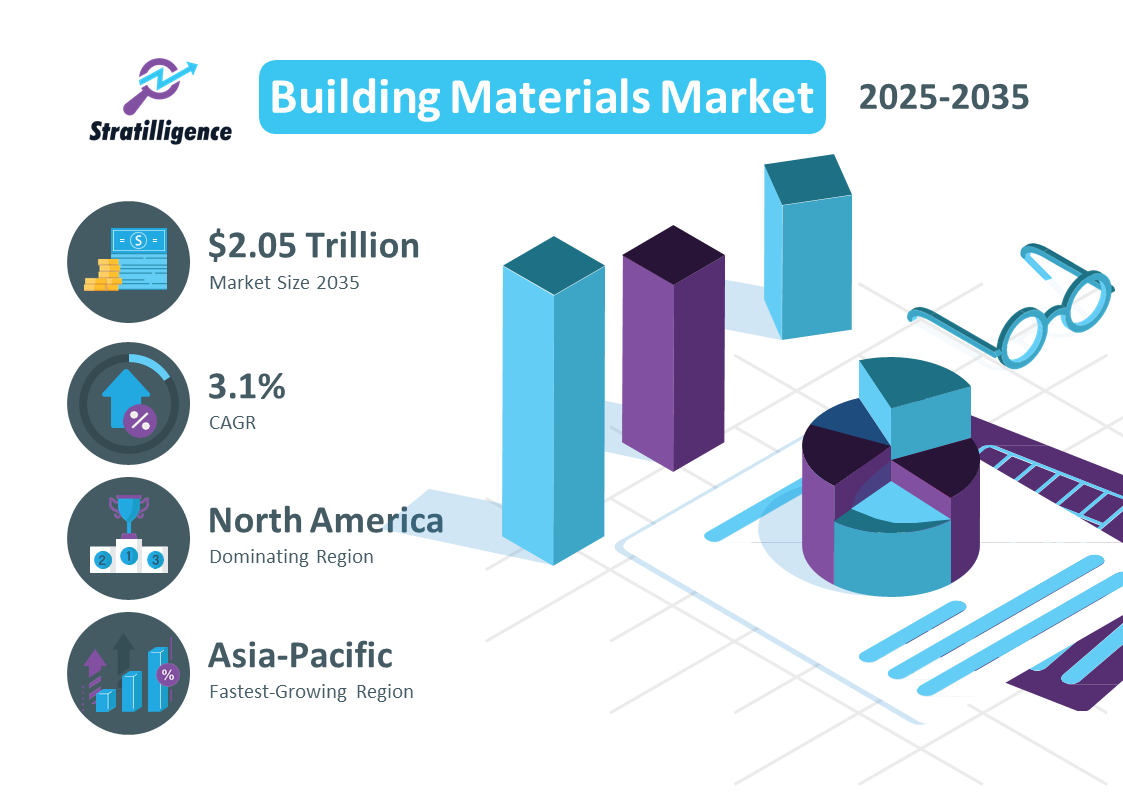
The market for building materials is essential to sustaining the demands of urbanization and infrastructure around the world. It is a fundamental industry that supports industrial construction, public works projects, transportation infrastructure, and real estate development. Key demand drivers in emerging economies like China, Brazil, and India include rising disposable incomes, rapid population growth, and urbanization. Additionally, government programs that support green buildings, smart cities, and affordable housing are driving the market’s continued growth.
The market for building materials is changing due to sustainability trends, as there is an increasing need for recyclable, energy-efficient, and environmentally friendly materials. Low-carbon cement, transparent wood, and self-healing concrete are examples of innovations that are becoming more popular. In the meantime, digital construction technologies like modular construction and Building Information Modeling (BIM) are decreasing construction waste and improving material usage efficiency.
With growing demand for recyclable, energy-efficient, and environmentally friendly materials, sustainability trends are changing the building materials market. Innovations like low-carbon cement, transparent wood, and self-healing concrete are becoming more popular. Simultaneously, digital construction technologies such as modular construction and Building Information Modeling (BIM) are decreasing construction waste and improving material usage efficiency.
Key Market Drivers and Growth Factors in the Building Materials Market
Urbanization, infrastructure development, and growing disposable incomes in emerging markets are driving the building materials market’s continued rapid expansion. The demand for cement, steel, and contemporary finishes in construction is rising due to the annual increase of over 50 million urban dwellers in Asia and Africa, according to UN data. Government spending on smart city projects, affordable housing, and transit corridors in nations like Saudi Arabia, Brazil, Indonesia, and India is also driving market growth.
Demand for recycled aggregates and low-carbon cement is rising as a result of sustainability regulations and green building standards (such as LEED, BREEAM, and India’s GRIHA). In 2025, for example, CarbonCure and St. Marys Cement signed a strategic partnership to inject captured CO₂ into concrete, lowering carbon emissions while increasing strength. The partnership is expected to save 50,000 tons of CO₂ annually per plant.
In a similar vein, China’s HBIS Group declared in March 2025 that it would be expanding its production facilities for recycled steel and environmentally friendly aggregates in Guangdong province in order to satisfy the growing demand for green buildings. The market for building materials is also growing as a result of growing investments in renewable energy infrastructure, such as wind turbine towers, solar panel support structures, and energy-efficient facades.
Restraints in the Building Materials Market
Despite the optimism, the market for building materials is challenged by a number of factors. The volatility of raw material prices, especially for steel and cement, can have a significant effect on manufacturers’ and builders’ profit margins. The COVID-19 pandemic’s supply chain disruptions (port delays, logistics) revealed weaknesses in the world’s material sourcing. Import/export dynamics are impacted and compliance costs are increased by stricter environmental regulations, such as the EU’s carbon border adjustment mechanisms (CBAM). Last but not least, rising wages in developed markets and a lack of skilled labor raise construction costs, which could impede the uptake of materials and project pipelines.
Technological Advancements Shaping the Building Materials Market
The building materials market is changing due to production advancements and new product development.
-
Low-carbon cement technologies, such as carbon capture and utilization and clinker substitution, are lowering CO₂ emissions per ton by as much as 50%, which is in line with the ESG objectives of large producers. For example, LafargeHolcim reported in April 2025 that geopolymer cement, a less-emitting substitute for conventional Portland cement, had been successfully tested in several Middle Eastern markets.
-
Self-healing concrete increases the lifespan of infrastructure and lowers maintenance costs by repairing cracks with encapsulated bacteria or microcapsules.
-
Project timelines are accelerated, waste is decreased, and material utilization efficiency is increased with modular construction and 3D-printed building materials.
-
In environmentally conscious urban design, smart façade systems with integrated solar cells, dynamic glass, and energy-efficient insulated panels are becoming more and more popular.
Another important factor is digital transformation: construction management platforms and Building Information Modeling (BIM) optimize material procurement, schedule deliveries, and make highly accurate material usage predictions. In large-scale developments, these tools are crucial for controlling waste and risk.
Coverage of the report
| Scope | Details |
|---|---|
| Market Size Estimation | Quantitative Insights: Market size and projections from 2021 to 2035, Market Size Units: USD Million |
| Market Dynamics | Analysis of drivers, restraints, and trends shaping the hydrogen fluoride market |
| Industry Analysis | Value chain analysis, Profit margin analysis, and Industry Overview |
| Segmentation | Material Type (Cement, Aggregates, Bricks and Blocks, Metal, and Others), Application (Residential, Commercial, and Industrial Construction), End-users (Professionals and DIY), and Distribution Channels (Direct Channels and Indirect Channels) |
| Region Insights | Detailed analysis for North America, Europe, Asia-Pacific, Latin America, and MEA with key countries in each region |
| Competitive Analysis | Company profiles, Ranking/Market share analysis, Competitive structure, Product differentiation |
| Customer Landscape Analysis | In-depth understanding of the customer industry, preferences, and buying patterns |
| Supplier Analysis | Comprehensive analysis of suppliers |
Key Benefits for Stakeholders
This comprehensive report provides stakeholders with in-depth qualitative and quantitative analyses, focusing on the building materials market from 2021 to 2035.
Key benefits include:
- Insightful Building Materials Market Forecast: The report offers detailed projections, covering various segments, current trends, and market dynamics.
- Competitive Analysis with Porter’s Five Forces: A thorough examination of the bargaining power of buyers and suppliers, the threat of new entrants, competitive rivalry, and substitute products.
- Comprehensive Market Overview: Gain access to crucial information about key market drivers, restraints, and opportunities.
- Regional and Country-Level Mapping: The report maps out major regions and countries based on their revenue contribution to the global building materials market.
- Market Player Positioning: The competitive landscape analysis provides a clear understanding of the current market positioning of key players.
Segmentation Analysis of the Building Materials Market
By Material Type
Cement, aggregates, concrete, bricks, metal, glass, wood, plastic, and other materials make up the building materials market. Because of its widespread use in housing and infrastructure projects around the world, cement continues to be the largest subsegment among these. It is a basic building material used in both residential and non-residential structures. Cement has continued to be in high demand, particularly in rapidly developing nations like China, India, and Indonesia. However, due to growing urbanization and time-sensitive construction projects that demand reliable and efficient material delivery, the ready-mix concrete segment is expected to expand at the fastest rate during the forecast period.
By Application
Additionally, the building materials market is divided into three segments: residential, commercial, and industrial construction. Because of the expanding global population, the fast urban migration, and government programs supporting affordable housing, the residential segment currently holds the largest share. In parts of Africa and Asia-Pacific, this trend is especially apparent. However, as investments in hotels, shopping centers, office buildings, and logistics parks increase—especially in developing nations going through urbanization and modernization—the commercial construction sector is expected to expand quickly.
By End Users
The building materials market caters to Professionals and Do-It-Yourself (DIY). Due to their extensive procurement for ongoing residential and commercial projects, real estate developers control this market. Nonetheless, the DIY market is exhibiting significant growth potential, particularly in developed markets such as North America and Europe, where post-pandemic consumer interest in home improvement projects has increased dramatically. The growth of this market is also being fueled by e-commerce sites that sell building supplies online.
By Distribution Channel
Direct channels, such as business-to-business sales to developers and construction companies, and indirect channels, such as retail establishments, wholesalers, and internet platforms, are used to distribute building materials. Because of their volume-based transactions and cost-effectiveness, direct sales are the most popular. However, because of the ease of price comparison, contactless delivery options, and growing digital adoption, online distribution channels are predicted to expand at the fastest rate. This trend is being further accelerated by some retailers’ integration of AR/VR technologies to replicate how products would appear in homes.
Regional Analysis of the Building Materials Market
North America
Because of its steady investments in residential real estate, commercial real estate, and infrastructure upgrades, the US leads the mature North American building materials market. More than $1 trillion is being invested in public infrastructure by the Infrastructure Investment and Jobs Act, which was passed in the US. This is greatly increasing demand for steel, insulation, cement, and asphalt. The demand for housing in major cities like Toronto and Vancouver, as well as sustainability trends that encourage the construction of green and energy-efficient buildings, are driving Canada’s market’s steady growth. Another factor promoting market expansion in the area is the trend toward prefabricated and modular construction.
Europe
With a strong construction industry and strict sustainability regulations, Germany leads Europe in the building materials market worldwide. The demand for environmentally friendly products like recycled concrete, insulation, and sustainable wood is being shaped by the region’s emphasis on green building practices and the circular economy. Public and private investments in affordable housing and energy-efficient buildings are driving recovery-driven growth in the UK and France, respectively, following Brexit and the pandemic. Building retrofits are becoming more common as a result of the EU’s Green Deal, which aims to achieve climate neutrality by 2050. This is increasing the demand for the advanced building materials market.
Asia-Pacific
The building materials market is expanding at the fastest rate in Asia-Pacific due to the region’s rapid industrialization, population growth, and urbanization. Thanks to its extensive infrastructure and smart city initiatives, China is the region’s largest consumer of steel and cement worldwide. The government’s “Housing for All” program, Smart Cities Mission, and industrial corridor projects are all contributing to India’s rapid development. The emphasis on earthquake-resistant structures and smart construction in South Korea and Japan is driving up demand for high-performance materials like high-strength concrete and engineered wood. Regional demand is also being fueled by an increase in manufacturing facilities and foreign direct investment.
Latin America
The building materials market is expanding moderately in Latin America, with Mexico and Brazil being the main contributors. Demand is being driven by government-led infrastructure projects, growing urban middle-class populations, and a renewed emphasis on housing. Construction activity is being stimulated by Mexico’s recovery of the tourism and commercial sectors and Brazil’s continuous efforts to modernize favelas, or informal housing settlements. Inflation pressures and economic instability in certain nations, however, might serve as barriers. Nevertheless, the region is seeing a rise in the use of economical and environmentally friendly materials.
Middle East & Africa
The UAE and Saudi Arabia are the main drivers of the MEA region’s strong growth, with multibillion-dollar megaprojects like Expo legacy developments, the Red Sea Project, and NEOM City creating a huge demand for cutting-edge building materials. Green buildings, smart cities, and luxury construction are becoming more and more popular. With rising expenditures on affordable housing and transportation infrastructure, South Africa and Kenya are driving construction activity in Africa. The market’s long-term potential is being supported by international partnerships and aid, which are assisting in bridging funding gaps and political instability in some African regions.
Competition Analysis of the Building Materials Market
Prominent companies operating in the building materials market include a wide range of global players known for their extensive portfolios and strong distribution networks. Some of the major companies in this space are 3M Company, Alcoa Corporation, Armstrong World Industries, Inc., BASF SE, Boral Limited, CRH plc, CEMEX S.A.B. de C.V., DuPont de Nemours, Inc., GAF Materials Corporation, Heidelberg Materials AG, James Hardie Industries plc, Knauf Gips KG, LafargeHolcim Ltd, Nichiha Corporation, Owens Corning, Saint-Gobain S.A., Sherwin-Williams Company, Sika AG, United States Gypsum Company (USG Corporation), and Vulcan Materials Company.
These players are continuously investing in R&D, M&A, and geographic expansion to strengthen their position in the global building materials market.
Key Developments/ Strategies in the Building Materials Market
-
In November 2024, Heidelberg Materials paid $600 million to acquire Giant Cement Holding, Inc. (East Coast U.S.), increasing its presence in the New England and Southeastern U.S. markets. This expands on its previous attempts to maximize its worldwide portfolio.
-
Heidelberg Materials, the first large-scale industrial carbon capture plant in the United Kingdom, started capturing CO₂ at its Padeswood cement works in Wales in May 2025 with the goal of sequestering up to 800,000 tonnes of CO₂ per year.
-
Heidelberg’s strategic refocus was furthered in January 2025 when it sold its 91% stake in a cement plant in the Democratic Republic of the Congo, continuing portfolio optimization.
-
In February 2025, Saint-Gobain finalizes its acquisition of FOSROC (construction chemicals), enhancing its footprint in emerging markets and Asia.
-
By introducing low-carbon gypsum plasters in April 2024, Saint-Gobain Gyproc India established itself as a pioneer in sustainable building solutions in India and reduced the lifecycle global warming potential by more than 40%.
-
Saint-Gobain Glass India advanced its eco-friendly material offerings by starting to produce its first low-carbon glass in June 2023.
-
In May 2022, Holcim Group announced that it was leaving India by selling Ambuja Cements and ACC to the Adani Group for $10.5 billion.
-
As part of its NextGen Growth 2030 strategy, Holcim finished the spin-off and U.S. listing of its North American operations (called “Amrize”) in June 2025.
-
To further its commitment to sustainability, Holcim signed a joint intent in January 2024 to add 1,000 Mercedes-Benz eActros 600 electric trucks to its fleet of logistics vehicles in Europe.
To explore the complete range of topics and critical insights our report offers, including comprehensive chapter names and pivotal sections, we invite you to submit a request for a detailed sample. Your inquiry will unlock an in-depth perspective on the report’s valuable content.
Chapter 1: Executive Summary
-
- Overview of the report
- Key findings and insights
- Market Entry Strategy (Add-on)
- Strategic Recommendation
Chapter 2: Introduction
Chapter 3: Market Overview
Chapter 4: Building Materials Market, by Material Type
Chapter 5: Building Materials Market, by Application
Chapter 6: Building Materials Market, by End-users
Chapter 7: Building Materials Market, by Distribution Channels
Chapter 8: Building Materials Market, by Region
Chapter 9: Building Materials Market, by Country
Chapter 10: Customer Industry Analysis (Add-on)
-
- Price Sensitivity Analysis
- Purchase Criteria Analysis
- XX
- XX
- XX
- XX
- XX
- XX
- XX
- XX
- XX
Chapter 11: Supplier Analysis (Add-on)
-
- Industry Structure Analysis
- Switching Cost Analysis
- XX
- XX
- XX
- XX
- XX
Chapter 12: Competitive Landscape
Chapter 13: Company Profiles