Follow Us :

Cannabis Beverages Market Report: Size, Share, Trends, and Forecast (2024-2033) – By Product Type, Beverage Type, Packaging Type, Distribution Channel, and End-use
- Report ID: STAR5325
- Industry: Beverages
- Published Date: 24-06-2025
- NUMBER OF PAGES: 242
-
FORMAT:



Cannabis Beverages Market Research: 2035
The global cannabis beverages market size was valued at $1,435 million in 2024 and is projected to reach $12,275.7 million by 2035, growing at a CAGR of 21.5% from 2025 to 2035. The market is witnessing significant momentum due to an ongoing shift in consumer preferences, rapid regulatory evolution, and the rising popularity of low- and no-alcohol alternatives among health-conscious consumers.
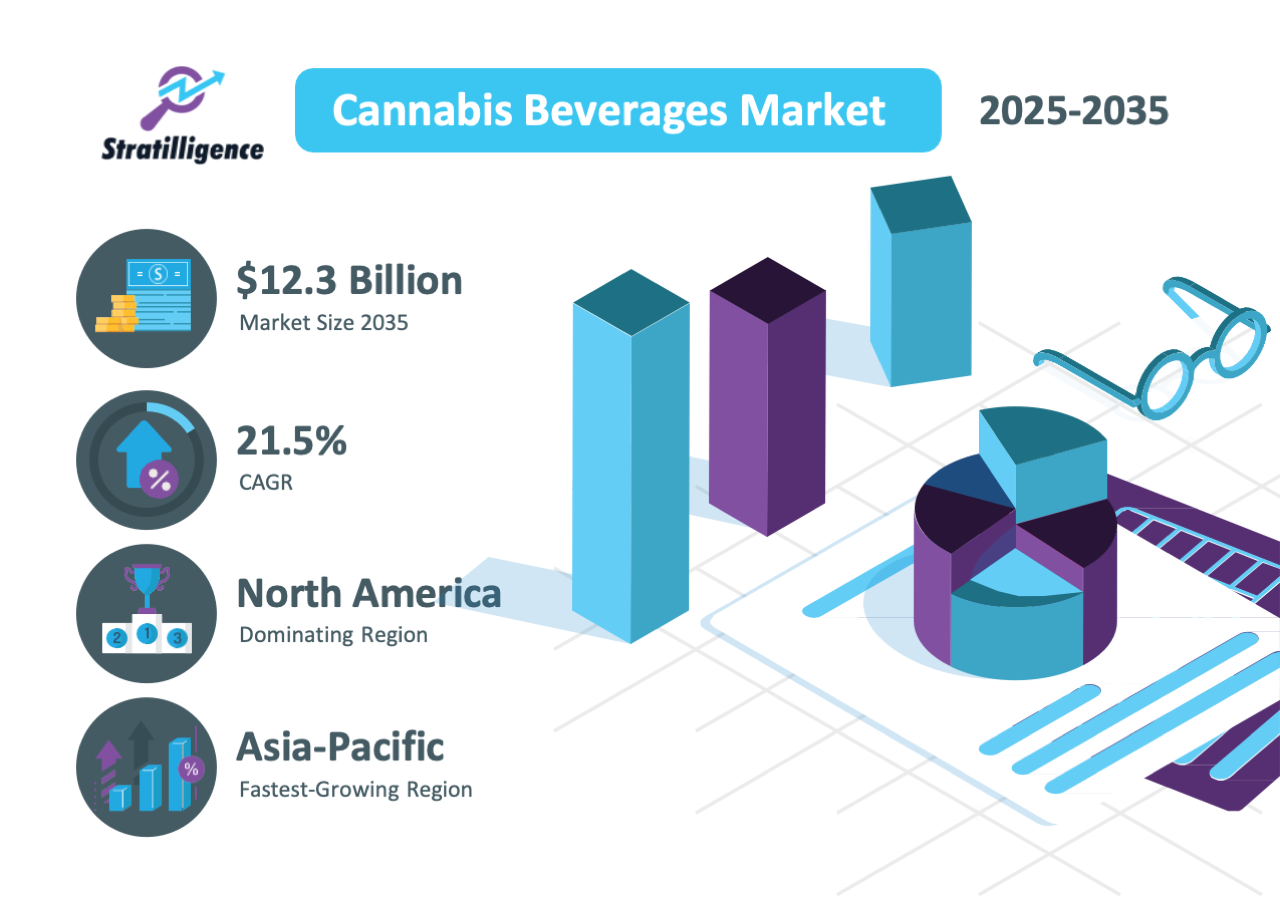
Cannabis beverages, ranging from CBD-infused teas and sparkling waters to THC-based sodas and cocktails, are emerging as a new functional beverage category, disrupting traditional alcohol and wellness drink markets. This trend is particularly pronounced in countries with progressive cannabis regulations, such as Canada, the U.S., Germany, and Thailand.
The market’s growth trajectory is also fueled by increasing investments from mainstream beverage manufacturers, formulation innovations (e.g., nanotechnology for better bioavailability), and expanding retail access across both physical and digital channels.
Coverage of the report
| Scope | Details |
|---|---|
| Market Size Estimation | Quantitative Insights: Market size and projections from 2019 to 2035, Market Size Units: USD Billion |
| Market Dynamics | Analysis of drivers, restraints, and trends shaping the market |
| Industry Analysis | Value chain analysis, Profit margin analysis, and Industry Overview |
| Segmentation | By Product Type (CBD-Infused Beverages and THC-Infused Beverages), By Beverage Type (Alcoholic and Non-alcoholic), By Packaging Type (Bottles, Cans, and Others), By Distribution Channel (Online and Offline), and By End-use (Recreational Use and Medical Use) |
| Region Insights | Detailed analysis for North America, Europe, Asia-Pacific, Latin America, and MEA with key countries in each region |
| Competitive Analysis | Company profiles, Ranking/Market share analysis, Competitive structure, Product differentiation |
| Customer Landscape Analysis | In-depth understanding of the customer industry, preferences, and buying patterns |
| Supplier Analysis | Comprehensive analysis of suppliers |
Key Benefits for Stakeholders
This comprehensive report provides stakeholders with in-depth qualitative and quantitative analyses, focusing on the global cannabis beverages market from 2025 to 2035.
Key benefits include:
- Insightful Cannabis Beverages Market Forecast: The report offers detailed projections, covering various segments, current cannabis beverages market trends, and dynamics.
- Competitive Analysis with Porter’s Five Forces: A thorough examination of the bargaining power of buyers and suppliers, the threat of new entrants, competitive rivalry, and substitute products.
- Comprehensive Cannabis Beverages Market Outlook Overview: Gain access to crucial information about key market drivers, restraints, and opportunities.
- Regional and Country-Level Mapping: The report maps out major regions and countries based on their revenue contribution to the global cannabis beverages market opportunity.
- Market Player Positioning: The competitive landscape analysis provides a clear understanding of the current market positioning of key players in the global cannabis beverages culture industry.
Key Market Drivers and Growth Factors in the Cannabis Beverages Market
Shift in Consumer Preferences Toward Healthier Alternatives
There is a growing preference for functional beverages that offer physiological or psychological benefits beyond hydration. Cannabis-infused beverages are increasingly viewed as wellness-enhancing alternatives to alcoholic drinks, appealing to consumers seeking to avoid intoxication, hangovers, or excessive sugar intake.
In particular, CBD beverages are being marketed as stress-relieving, anti-inflammatory, and sleep-aiding solutions. With the rising influence of Gen Z and millennials—cohorts that prioritize mental well-being, productivity, and social alternatives to alcohol—brands are tailoring cannabis beverages with clear functional positioning.
Legalization and Regulatory Reforms
The global cannabis industry is undergoing rapid legal transformation. In 2024, Germany approved adult-use cannabis for personal consumption, setting the stage for commercial THC product development, including beverages. In the U.S., the FDA and DEA began formal discussions to reschedule cannabis, potentially removing significant legal hurdles for product development and interstate commerce.
Additionally, countries such as Thailand, Australia, and Colombia are relaxing regulations around CBD and hemp-derived THC, enabling product trials and limited commercial activity. This global liberalization is opening up previously untapped markets and encouraging cross-border partnerships.
Industry Innovation and R&D Advancements
Companies are investing in nanoemulsion and microencapsulation technologies to address solubility and taste issues associated with cannabis-infused beverages. These innovations ensure better bioavailability, faster onset times, and consistent dosing—critical factors in gaining consumer trust.
New formulations that blend cannabinoids with botanicals, nootropics, adaptogens, and even caffeine are expanding the use cases of cannabis drinks, ranging from energy boosters and social lubricants to sleep aids and workout recovery solutions.
Challenges and Restraints in the Cannabis Beverages Market
Regulatory Ambiguity and Fragmentation
Despite growing legalization, cannabis beverage regulation remains inconsistent across and even within countries. In the U.S., hemp-derived beverages containing Delta-9 THC are technically legal under the 2018 Farm Bill (if THC content ≤0.3%), but individual states such as Texas and Arizona are imposing stricter rules or outright bans in 2025.
This patchwork legal landscape makes it difficult for brands to operate uniformly, affecting distribution planning, pricing, packaging, and compliance costs. Moreover, the lack of harmonized safety standards has prompted scrutiny from public health organizations and lawmakers.
Consumer Awareness and Stigma
While awareness of CBD has increased, many consumers remain unfamiliar with safe dosing, functional benefits, and the difference between hemp and marijuana-based drinks. Misinformation, historical stigma, and skepticism about psychoactive effects are slowing adoption in conservative markets.
Brands must continue to invest in educational marketing and third-party safety certifications to build consumer confidence and normalize cannabis beverages as part of everyday routines.
Cannabis Beverages Market Segmentation
Cannabis Beverages Market is bifurcated based on product type, beverage type, packaging type, distribution channel, and end-use. By product type, the market is categorized into CBD-infused beverages and THC-infused beverages. CBD-infused beverages currently account for a larger market share, primarily due to their broader legal status across international markets and their appeal to wellness-focused consumers. These products are often positioned as calming, anti-inflammatory, or non-psychoactive alternatives.
On the other hand, THC-infused beverages are gaining traction, particularly in North America, where recreational cannabis use is legalized in several jurisdictions. These products offer controlled psychoactive experiences and are increasingly being consumed in social and lifestyle settings. The THC segment is expected to register a higher CAGR during the forecast period, driven by expanding legalization and growing consumer familiarity.
Based on beverage type, the market is segmented into alcoholic and non-alcoholic cannabis beverages. Non-alcoholic beverages dominate the segment and include infused waters, teas, sodas, and wellness drinks. These formats appeal to health-conscious consumers looking for functional benefits without alcohol or sugar content. The rising popularity of “sober-curious” lifestyles and alcohol alternatives has also accelerated demand in this segment.
Meanwhile, alcoholic cannabis beverages—such as beer and wine infused with THC or CBD—remain a niche category due to regulatory complexity, particularly in jurisdictions where alcohol and cannabis cannot be legally combined in a single product. However, innovations in this space continue to emerge, especially in Canada and select U.S. states.
In terms of packaging, the cannabis beverage market is segmented into bottles, cans, and others (such as sachets or pouches). Bottled cannabis drinks, especially glass or PET bottles, have been the traditional choice for manufacturers due to familiarity and premium perception.
However, canned cannabis beverages are rapidly gaining preference owing to their portability, convenience, and ease of stacking for retail display. Slim cans in particular have gained popularity among younger consumers and are often used for single-serve or microdosed THC beverages. Alternative packaging formats like pouches are more common in powdered drink mixes or concentrates, offering additional innovation opportunities for product differentiation.
The market is segmented by distribution into online and offline channels. Offline distribution, which includes dispensaries, specialty cannabis retailers, and increasingly, convenience and liquor stores, remains the dominant sales channel due to legal restrictions and ID verification requirements. Dispensaries play a crucial role in product education and consumer trust, particularly for THC-based beverages.
However, the online channel is expanding, especially in regions with more relaxed regulations for CBD products. E-commerce platforms and brand-owned websites are helping companies reach a broader consumer base, offer detailed product information, and enable subscription-based models. The online segment is expected to grow significantly over the forecast period as digital access expands and consumer purchasing behavior shifts.
Based on end use, the market is segmented into recreational and medical consumption. Recreational use leads the market, fueled by the increasing normalization of cannabis as a lifestyle choice and the growing preference for cannabis beverages in social settings. The segment includes adult consumers using cannabis drinks for relaxation, mood enhancement, or as a substitute for alcohol.
On the other hand, the medical use segment is steadily growing, especially in markets where cannabis beverages are prescribed for chronic pain, anxiety, sleep disorders, and neurological conditions. These drinks offer patients a smoke-free and easily dosable alternative, often preferred over edibles or inhalables.
Regional Analysis of the Global Cannabis Beverages Market
Region-wise, the cannabis beverages market analysis is conducted across North America (the U.S. and Canada), Europe (UK, France, Germany, Italy, and Rest of Europe), Asia-Pacific (China, Japan, Australia, South Korea, and Rest of Asia-Pacific), and Latin America (Brazil, Mexico, Argentina, and Rest of Latin America), and MEA (Saudi Arabia, UAE, Kenya, South Africa, and Rest of Middle East & Africa).
Competition Analysis
The major players profiled in the cannabis beverages market report, having significant market share, include CANN SOCIAL TONICS; ARTET, LLC; and VCC BRANDS.; Keef Brands; BellRock Brands (Dixie Brands); Aphria Inc. (Tilray); Canopy Growth (Tweed); FABLE; Mary Jones; Teapot (Boston Beer Company, Inc.).
Key Developments/ Strategies in Cannabis Beverages Market
Major companies operating in the cannabis beverage market have adopted strategies such as product launches, partnerships, acquisitions, and retail expansion to strengthen their market position and expand access to consumers. These strategic initiatives are aimed at enhancing product portfolios, improving bioavailability and dosing precision, and entering newly regulated markets. Such developments are contributing significantly to the growth and diversification of the global cannabis beverage market.
- In 2023, Tilray Brands acquired the remaining stake in Truss Beverage Co., a joint venture it previously operated with Molson Coors in Canada. This acquisition made Tilray the largest player in the Canadian cannabis beverage market, enabling it to streamline its product offerings and expand into new regional markets with improved operational control.
- In 2024, Curaleaf Holdings, Inc. launched a line of hemp-derived THC energy drinks, targeting consumers seeking alternatives to traditional caffeinated beverages. These products are now available in select U.S. retail stores outside the dispensary model, signaling an expansion of cannabis beverages into mainstream distribution.
- In 2024, Wana Brands introduced Wanderous, a dedicated e-commerce platform for legal hemp-derived THC and CBD beverages. This move capitalizes on the growing online demand and enables the brand to reach consumers in states where direct-to-consumer shipping is permitted under federal law.
- In 2023, Brez, a U.S.-based startup, secured large-scale distribution partnerships with Total Wine & More and Binny’s Beverage Depot, bringing its microdosed THC seltzers to over 3,000 retail locations nationwide. The company’s retail-first approach has helped normalize cannabis beverages among traditional alcohol consumers.
- In 2024, Lagunitas Brewing Company (a subsidiary of Heineken N.V.) continued to expand its Hi-Fi Hops line in California, one of the most mature recreational cannabis markets. By introducing new THC: CBD ratio formulations and targeting social consumption lounges, the company is diversifying its product use cases.
- In 2024, Canopy Growth Corporation strengthened its cannabis beverage portfolio by enhancing its production technology in collaboration with its long-term investor, Constellation Brands. The partnership is focused on improving shelf stability, flavor consistency, and faster onset times through nanoemulsion techniques.
To explore the complete range of topics and critical insights our report offers, including comprehensive chapter names and pivotal sections, we invite you to submit a request for a detailed sample. Your inquiry will help gain an in-depth perspective on the report’s valuable content.
Chapter 1: Executive Summary
-
- Overview of the report
- Key findings and insights
- Market Entry Strategy (Add-on)
- Strategic Recommendation
Chapter 2: Introduction
Chapter 3: Market Overview
Chapter 4: Cannabis Beverages Market, by Product Type
Chapter 5: Cannabis Beverages Market, by Beverage Type
Chapter 6: Cannabis Beverages Market, by Packaging Type
Chapter 7: Cannabis Beverages Market, by Distribution Channel
Chapter 8: Cannabis Beverages Market, by End-use
Chapter 9: Cannabis Beverages Market, by Region
Chapter 10: Cannabis Beverages Market, by Country
Chapter 11: Customer Industry Analysis (Add-on)
-
- Price Sensitivity Analysis
- Purchase Criteria Analysis
- XX
- XX
- XX
- XX
- XX
- XX
- XX
- XX
- XX
Chapter 12: Supplier Analysis (Add-on)
-
- Industry Structure Analysis
- Switching Cost Analysis
- XX
- XX
- XX
- XX
- XX
Chapter 13: Competitive Landscape
Chapter 14: Company Profiles