Follow Us :

Microfinance Market Report: Size, Share, Trends, and Forecast (2024-2033) – By Provider and End-users
- Report ID: STAR4425
- Industry: Finance & Banking
- Published Date: 23-05-2025
- NUMBER OF PAGES: 217
-
FORMAT:



Microfinance Market Research: 2033
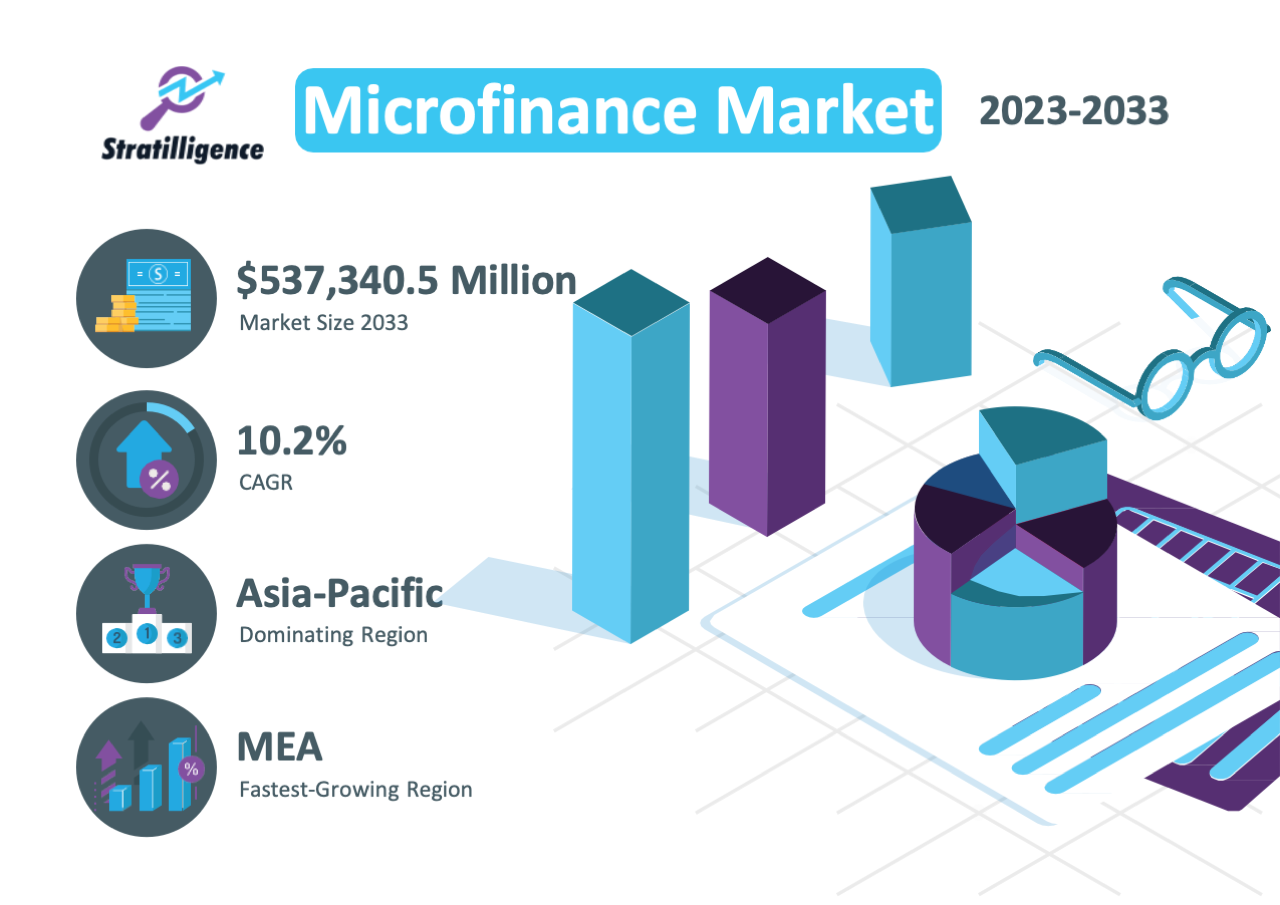
The global microfinance market size was valued at $ 201,200.2 million in 2023 and is projected to reach $537,340.5 million by 2033, growing at a CAGR of 10.2% from 2024 to 2033. Microfinance refers to a financial service aimed at individuals and small businesses that lack access to conventional banking and financial services. It encompasses various financial products, including microloans, savings accounts, insurance, and payment services, typically aimed at low-income clients or those in developing regions.
Microfinance provides access to financial services for underserved populations, enabling them to participate in the economy and improve their living standards. It empowers individuals, especially women, by providing them with the financial resources necessary to start or grow small businesses, fostering entrepreneurship and self-sufficiency.
The microfinance market plays a pivotal role in promoting financial inclusion by providing essential financial services for low-income populations through microcredit and microfinance institutions (MFIs). Group lending models facilitate access to funds for small and medium enterprises (SMEs), empowering entrepreneurs and fostering community support. The rise of digital microfinance and mobile banking in microfinance has transformed service delivery, making it more accessible and efficient. Additionally, a focus on financial literacy and empowerment is crucial for clients to make informed decisions. As the sector evolves, regulatory compliance in microfinance remains essential to ensure responsible lending practices, while the impact of fintech on microfinance continues to enhance innovation and reach within underserved markets.
Key Market Drivers and Growth Factors in the Microfinance Market
The microfinance market is driven by several key factors that contribute to its growth. Firstly, the increasing demand for financial inclusion among low-income populations creates a substantial need for microcredit and accessible financial services. The rise of small and medium enterprises (SMEs) in developing economies further fuels this demand, as these businesses seek funding to grow and thrive. Additionally, advancements in digital microfinance and mobile banking technologies have made it easier for microfinance institutions (MFIs) to reach remote clients, enhancing service delivery and operational efficiency.
Moreover, growing awareness of the importance of financial literacy and empowerment helps clients make better financial decisions, leading to higher repayment rates and sustainability. The supportive regulatory environment also encourages the establishment and growth of MFIs, while partnerships with fintech companies drive innovation and expand product offerings. Lastly, the focus on sustainable development goals (SDGs) highlights the role of microfinance in alleviating poverty, which attracts investment and further propels market expansion.
Financial Inclusion
One of the primary drivers of the microfinance market is the push for financial inclusion. Many low-income individuals and communities lack access to traditional banking services, making it challenging for them to secure loans or manage savings effectively. Microfinance institutions (MFIs) fill this gap by offering small loans, or microcredit, that empower individuals to start or expand small businesses, ultimately contributing to economic stability and growth within underserved populations.
Digital Transformation
The rapid advancement of technology, particularly in digital microfinance and mobile banking, is another significant driver of market growth. These technologies have revolutionized how MFIs operate, allowing them to streamline processes, reduce costs, and enhance customer engagement. Clients can access financial services conveniently through their mobile devices, increasing outreach to remote areas and improving overall accessibility, which in turn boosts the adoption of microfinance products.
Supportive Regulatory Environment
A supportive regulatory environment is crucial for the growth of the microfinance sector. Governments and regulatory bodies are increasingly recognizing the importance of microfinance in promoting economic development and poverty alleviation. By implementing favorable policies, such as lower capital requirements and the establishment of regulatory frameworks, they encourage the establishment and expansion of MFIs. This regulatory support helps build trust among investors and clients, fostering a more robust microfinance ecosystem.
Microfinance Market Segmentation
The Microfinance market is bifurcated based on provider and end user. Providers covered in the study include banks, Micro Finance Institute (MFI), NBFC (Non-Banking Financial Institutions), and others. In 2023. The Micro Finance Institute (MFI) segment was the largest in terms of revenue. MFIs are specifically designed to cater to low-income populations and underserved markets. Unlike traditional banks, which may have stringent lending criteria and focus primarily on larger loans, MFIs specialize in providing smaller loans and tailored financial services that meet the unique needs of micro-entrepreneurs and small businesses.
By end user, the market is segregated into small enterprises, micro enterprises, and solo entrepreneurs or self-employed. In 2023, the micro-enterprises segment was the largest in terms of revenue. Micro enterprises, which often consist of small businesses with limited access to traditional financing, have a significant need for microloans to sustain operations, purchase inventory, and invest in growth. This segment encompasses a large portion of the informal economy, which continues to expand in developing regions.
Coverage of the report
| Scope | Details |
| Market Size Estimation | Quantitative Insights: Microfinance Market size and projections from 2019 to 2033, Market Size Units: USD Million |
| Market Dynamics | Analysis of drivers, restraints, and insurance market trends shaping the industry |
| Industry Analysis | Value chain analysis, Profit margin analysis, and Industry Overview |
| Segmentation | Provider (Banks, Micro Finance Institute (MFI), NBFC (Non-Banking Financial Institutions), and Others), and End User (Small Enterprises, Micro Enterprises, and Solo Entrepreneurs or Self-Employed) |
| Region Insights | Detailed analysis for North America, Europe, Asia-Pacific, Latin America, and MEA with key countries in each region |
| Competitive Analysis | Company profiles, Ranking/Market share analysis, Competitive structure, Product differentiation |
| Customer Landscape Analysis | In-depth understanding of the customer industry, preferences, and buying patterns |
| Supplier Analysis | Comprehensive analysis of suppliers |
Key Benefits for Stakeholders
This comprehensive report provides stakeholders with in-depth qualitative and quantitative analyses, focusing on the global Microfinance market from 2023 to 2033.
Key benefits include:
- Insightful Microfinance Market Forecast: The report offers detailed projections, covering various segments, current trends, and market dynamics.
- Competitive Analysis with Porter’s Five Forces: A thorough examination of the bargaining power of buyers and suppliers, the threat of new entrants, competitive rivalry, and substitute products.
- Comprehensive Market Overview: Gain access to crucial information about key market drivers, restraints, and the Microfinance market opportunity.
- Regional and Country-Level Mapping: The report maps out major regions and countries based on their revenue contribution to the global Microfinance market share.
- Market Player Positioning: The competitive landscape analysis provides a clear understanding of the current market positioning of key players.
Regional Analysis of the Global Microfinance Market
Region-wise, the Microfinance market analysis is conducted across North America (the U.S. and Canada), Europe (UK, France, Germany, Italy, and Rest of Europe), Asia-Pacific (China, Japan, India, South Korea, and Rest of Asia-Pacific), Latin America (Brazil, Mexico, Argentina, and Rest of Latin America), and MEA (Saudi Arabia, UAE, Kenya, South Africa, and Rest of Middle East & Africa).
Competition Analysis
The major players profiled in the Microfinance market outlook, having significant market share included are Annapurna Finance (P) Ltd, Bank Rakyat Indonesia (BRI), Bandhan Bank, CDC Small Business Finance, Cashpor Micro Credit, Grameen America, Grameen Bank, Kiva, Madura Microfinance Ltd., and Pacific Community Ventures Inc.
Key Developments/ Strategies in the Microfinance Market
Major companies in the Microfinance industry have adopted product launch, partnership, business expansion, and acquisition as their key developmental strategies to offer better products and services to customers in the market, which is contributing to the Microfinance market growth.
- In 2024, Kotak Mahindra Bank is moving forward with the merger of its subsidiaries, Sonata Finance and BSS Microfinance. The merger aims to consolidate operations, streamline services, and enhance the overall efficiency of their microfinance offerings.
- In 2024, the European Bank for Reconstruction and Development (EBRD), along with a consortium of investors, successfully acquired Egypt’s Tamweely Microfinance. This acquisition is a strategic move aimed at enhancing the microfinance landscape in Egypt, where access to financial services for low-income populations is critical for economic development.
To explore the complete range of topics and critical insights our report offers, including comprehensive chapter names and pivotal sections, we invite you to submit a request for a detailed sample. Your inquiry will help gain an in-depth perspective on the report’s valuable content.
Chapter 1: Executive Summary
-
- Overview of the report
- Key findings and insights
- Market Entry Strategy (Add-on)
- Strategic Recommendation
Chapter 2: Introduction
Chapter 3: Market Overview
Chapter 4: Microfinance Market, by Provider
Chapter 5: Microfinance Market, by End-users
Chapter 6: Microfinance Market, by Region
Chapter 7: Microfinance Market, by Country
Chapter 8: Customer Analysis (Add-on)
-
- Price Sensitivity Analysis
- Purchase Criteria Analysis
- XX
- XX
- XX
- XX
- XX
- XX
- XX
- XX
- XX
Chapter 9: Supplier Analysis (Add-on)
-
- Industry Structure Analysis
- Switching Cost Analysis
- XX
- XX
- XX
- XX
- XX
Chapter 10: Competitive Landscape
Chapter 11: Company Profiles