Follow Us :

Sexually Transmitted Diseases (STD) Testing Market Report: Size, Share, Trends, and Forecast (2024-2033) – By Product Type, Application, Setting, and End-users
- Report ID: STAR6525
- Industry: Healthcare & Life Sciences
- Published Date: 19-06-2025
- NUMBER OF PAGES: 238
-
FORMAT:



Sexually Transmitted Diseases (STD) Testing Market Research: 2033
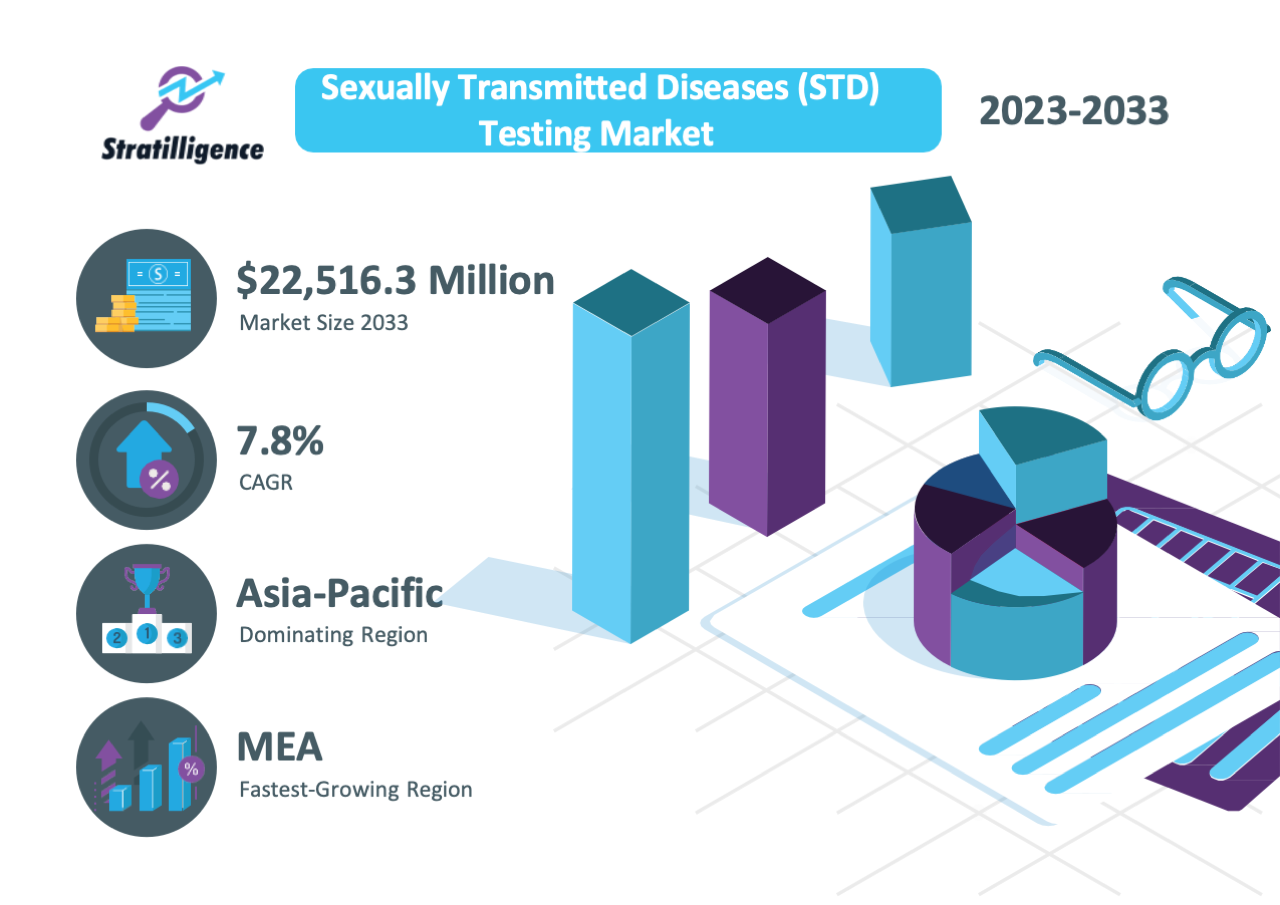
The global sexually transmitted diseases (STD) testing market size was valued at $10,701.1 million in 2023 and is projected to reach $22,516.3 million by 2033, growing at a CAGR of 7.8% from 2024 to 2033. The sexually transmitted diseases (STD) testing market encompasses a range of diagnostic procedures and technologies used to detect sexually transmitted infections (STIs) in individuals. These tests can include blood tests, urine tests, swabs, and rapid testing methods, and they target infections such as chlamydia, gonorrhea, syphilis, human immunodeficiency virus (HIV), and hepatitis, among others.
There are different testing methods available, such as laboratory-based testing, point-of-care testing, and home testing kits. STD testing serves several critical uses in healthcare and public health. First and foremost, it facilitates early detection of infections in asymptomatic individuals, allowing for timely treatment and reducing the risk of complications associated with untreated STDs. Regular testing plays a vital role in preventing the transmission of these infections to sexual partners, contributing to overall community health and reducing the spread of diseases.
Health authorities often recommend routine screenings for sexually active individuals, particularly those in high-risk groups, as a proactive measure to control outbreaks and monitor public health trends. Additionally, testing is crucial for pregnant women, as it helps prevent mother-to-child transmission of infections, ensuring better maternal and fetal health outcomes. Lastly, STD testing is essential before fertility treatments, as it assesses reproductive health and manages potential risks associated with STDs. Together, these uses underscore the importance of STD testing in promoting individual and public health.
The STD testing market is evolving significantly, with a strong emphasis on various forms of STD diagnostics, including Chlamydia testing, Gonorrhea testing, HIV testing, and Syphilis testing. Advances in Point of Care (POC) testing are enhancing the speed and accessibility of testing, allowing patients to receive results rapidly and conveniently, often within the same visit to a healthcare provider.
Moreover, home-based STD testing kits are gaining popularity, enabling individuals to test for Human Papillomavirus (HPV) and other STIs privately and efficiently. Public health initiatives aimed at increasing STI awareness and prevention are critical in combating the rising rates of these infections, highlighting the importance of regular testing and early diagnosis. Laboratory testing for STDs continues to play a vital role in confirming diagnoses and guiding treatment strategies, thus underlining the multifaceted approach needed to address public health challenges associated with STDs.
Key Market Drivers and Growth Factors in the Sexually Transmitted Diseases (STD) Testing Market
Increasing awareness about sexual health is a significant driver of the STD testing market. Educational campaigns and initiatives by public health organizations have been instrumental in informing individuals about the risks associated with sexually transmitted infections and the importance of regular testing. This heightened awareness encourages proactive behavior, leading to more people seeking out testing services to safeguard their health and that of their partners.
Additionally, discussions around sexual health have become more mainstream, reducing stigma and making individuals feel more comfortable addressing their sexual health needs. Social media and online platforms also play a crucial role in disseminating information, reaching broader audiences, and fostering open conversations about sexual health. As people become more informed, the demand for STD testing increases, ultimately contributing to better health outcomes and reduced transmission rates within communities.
The rising prevalence of STDs, particularly among younger populations and high-risk groups, has led to a greater demand for testing services and innovative diagnostic solutions. Technological advancements in testing methods, such as the development of rapid tests and at-home testing kits, have made STD testing more accessible and convenient, further driving market growth.
Moreover, the ongoing efforts by healthcare organizations to integrate STD testing into routine healthcare services and preventive care are enhancing its visibility and uptake. Government initiatives and funding for sexual health programs also support the expansion of testing services, particularly in underserved areas. Collectively, these drivers highlight the growing recognition of the need for effective STD testing as a critical component of public health strategies.
Coverage of the report
| Scope | Details |
|---|---|
| Market Size Estimation | Quantitative Insights: Market size and projections from 2019 to 2033, Market Size Units: USD Billion |
| Market Dynamics | Analysis of drivers, restraints, and trends shaping the market |
| Industry Analysis | Value chain analysis, Profit margin analysis, and Industry Overview |
| Segmentation | By Product Type (Instruments and Reagents & Kits), By Application (Chlamydia, Syphilis, Genital Herpes, Gonorrhea, Human Immunodeficiency Virus, Human Papillomavirus, and Others), By Setting (Laboratory Testing and Point-of-Care), and By End-users (Hospital & Clinics, Diagnostic Centers, and Others) |
| Region Insights | Detailed analysis for North America, Europe, Asia-Pacific, Latin America, and MEA with key countries in each region |
| Competitive Analysis | Company profiles, Ranking/Market share analysis, Competitive structure, Product differentiation |
| Customer Landscape Analysis | In-depth understanding of the customer industry, preferences, and buying patterns |
| Supplier Analysis | Comprehensive analysis of suppliers |
Key Benefits for Stakeholders
This comprehensive report provides stakeholders with in-depth qualitative and quantitative analyses, focusing on the global sexually transmitted diseases (STD) testing market from 2023 to 2033.
Key benefits include:
- Insightful Sexually Transmitted Diseases (STD) Testing Market Forecast: The report offers detailed projections, covering various segments, current Sexually transmitted diseases (STD) testing market trends, and dynamics.
- Competitive Analysis with Porter’s Five Forces: A thorough examination of the bargaining power of buyers and suppliers, the threat of new entrants, competitive rivalry, and substitute products.
- Comprehensive Sexually Transmitted Diseases (STD) Testing Market Outlook Overview: Gain access to crucial information about key market drivers, restraints, and opportunities.
- Regional and Country-Level Mapping: The report maps out major regions and countries based on their revenue contribution to the global sexually transmitted diseases (STD) testing market opportunity.
- Market Player Positioning: The competitive landscape analysis provides a clear understanding of the current market positioning of key players in the global sexually transmitted diseases (STD) testing industry.
Technological Advancements in Sexually Transmitted Diseases (STD) Testing Market
Technological advancements in testing methods have significantly transformed the landscape of the sexually transmitted diseases (STD) testing market. Innovations such as rapid testing kits enable individuals to receive results within minutes, enhancing convenience and encouraging more people to get tested. These tests often require minimal sample collection, making them less invasive and easier to use, which is particularly beneficial for those who may feel anxious about traditional testing methods.
Moreover, the development of at-home testing kits allows individuals to test for STDs in the privacy of their homes, further increasing accessibility and reducing the stigma associated with seeking testing. Additionally, improvements in laboratory testing techniques, such as polymerase chain reaction (PCR) and nucleic acid amplification tests (NAATs), have led to higher accuracy and sensitivity in detecting infections.
Further, the integration of mobile health technologies, including apps and telemedicine platforms, also facilitates easier access to testing and follow-up care. Overall, these advancements not only enhance the user experience but also play a crucial role in increasing testing rates and improving public health outcomes.
Challenges and Restraints in the Sexually Transmitted Diseases (STD) Testing Market
Despite the growth potential of the sexually transmitted diseases (STD) testing industry, several challenges and restraints hinder its progress. One significant issue is the persistent stigma surrounding STDs, which can deter individuals from seeking testing and treatment. Many people still feel embarrassed or ashamed to discuss their sexual health, leading to underreporting and untreated infections.
Additionally, there are disparities in access to testing services, particularly in rural or underserved areas where healthcare resources may be limited. The cost of testing can also be a barrier for some individuals, particularly those without insurance or inadequate coverage for sexual health services. Furthermore, the evolving nature of STDs and the emergence of antibiotic-resistant strains complicate diagnosis and treatment, necessitating ongoing innovation in testing methods. Regulatory hurdles and varying standards for testing accuracy can also impede sexually transmitted diseases (STD) testing market growth, as companies must navigate complex approval processes.
Lastly, the COVID-19 pandemic has shifted healthcare priorities and resources, which may have disrupted STD testing services and public health initiatives aimed at increasing awareness and access. Collectively, these challenges highlight the need for comprehensive strategies to improve testing rates and address the barriers faced by individuals seeking sexual health services.
Sexually Transmitted Diseases (STD) Testing Market Segmentation
The sexually transmitted diseases (STD) testing market is bifurcated based on product type, application, setting, and end user.
Based on product type, the market is segmented into instruments and reagents & kits. The reagents and kits segment has dominated the global sexually transmitted diseases (STD) testing market share due to the essential role they play in diagnostic procedures. These kits provide the necessary materials for accurate testing, including specific antibodies and other biochemical components required for detecting infections.
Their widespread availability and continual advancements in technology have made them crucial for laboratories and healthcare providers, facilitating rapid and reliable results. As a result, this segment’s growth is driven by the increasing demand for effective and efficient sexually transmitted diseases (STD) testing market industry solutions worldwide.
By application, the sexually transmitted diseases (STD) testing market is segmented into chlamydia, syphilis, genital herpes, gonorrhea, human immunodeficiency virus, human papillomavirus, and others. Chlamydia accounted for the largest share of the global sexually transmitted diseases testing market, primarily due to its high prevalence and asymptomatic nature in many cases. This infection is one of the most commonly reported STDs worldwide, prompting increased demand for testing and screening services.
Public health initiatives aimed at raising awareness and promoting regular testing further contribute to the focus on chlamydia, driving its significant sexually transmitted diseases (STD) testing market share. Consequently, the emphasis on early detection and treatment of chlamydia plays a critical role in reducing transmission rates and improving overall sexual health outcomes.
By setting, the market is divided into point-of-care testing and laboratory testing. The laboratory testing segment dominated the global sexually transmitted diseases testing market due to its established accuracy and reliability in diagnosing infections. Laboratory-based tests often employ advanced technologies, such as polymerase chain reaction (PCR) and enzyme immunoassays, which provide precise results and are crucial for confirming diagnoses. The ability to conduct a wide range of tests simultaneously and process samples from various locations enhances the efficiency of laboratory testing.
Additionally, healthcare providers and patients trust laboratory results for informed decision-making regarding treatment, further solidifying this segment’s leadership in the sexually transmitted diseases (STD) testing market. As a result, the laboratory testing segment remains a critical component of comprehensive STD management strategies worldwide.
By end-users, the market is classified into hospitals & clinics, diagnostic centers, and others. The diagnostic centers segment accounted for the largest share of the global sexually transmitted diseases testing market, primarily due to their specialized services and accessibility. These centers provide focused expertise in conducting a wide range of STD tests, often with quicker turnaround times for results. Their integration of advanced diagnostic technologies and skilled professionals enhances the quality of testing and patient care.
Additionally, the convenience of having multiple testing options in one location attracts more individuals seeking timely and confidential testing services, driving the segment’s significant sexually transmitted diseases (STD) testing market share.
Regional Analysis of the Global Sexually Transmitted Diseases (STD) Testing Market
Region-wise, the sexually transmitted diseases (STD) testing market analysis is conducted across North America (the U.S. and Canada), Europe (UK, France, Germany, Italy, and Rest of Europe), Asia-Pacific (China, Japan, India, South Korea, and Rest of Asia-Pacific), and Latin America (Brazil, Mexico, Argentina, and Rest of Latin America), and MEA (Saudi Arabia, UAE, Kenya, South Africa, and Rest of Middle East & Africa).
Competition Analysis
The major players profiled in the sexually transmitted diseases (STD) testing market report having significant market share included are Abbott Laboratories, Thermo Fisher Scientific, Roche Diagnostics, Becton, Dickinson and Company (BD), Cepheid, Inc., Hologic, Inc., Quidel Corporation, BioMerieux S.A., PerkinElmer, Inc., and Siemens Healthineers.
Key Developments/ Strategies in Sexually Transmitted Diseases (STD) Testing Market
Major companies in the sexually transmitted diseases (STD) testing market have adopted product launch, partnership, business expansion, and acquisition as their key developmental strategies to offer better products and services to customers in the market, which is contributing to the sexually transmitted diseases (STD) testing growth.
- In 2024, Testmate Health, a Swiss startup that raised $6 million to develop its rapid urine-based testing kits for chlamydia and gonorrhea. These kits allow users to test privately at home and receive results within 30 minutes, with subsequent connections to healthcare professionals for follow-up if needed
- In 2024, Binx Health, a health technology company, developed the Binx io point-of-care molecular platform, an FDA-cleared, CLIA-waived system. It is used in urgent care clinics and hospital emergency rooms to quickly diagnose chlamydia and gonorrhea, the two most common sexually transmitted diseases.
To explore the complete range of topics and critical insights our report offers, including comprehensive chapter names and pivotal sections, we invite you to submit a request for a detailed sample. Your inquiry will help gain an in-depth perspective on the report’s valuable content.
Chapter 1: Executive Summary
-
- Overview of the report
- Key findings and insights
- Market Entry Strategy (Add-on)
- Strategic Recommendation
Chapter 2: Introduction
Chapter 3: Market Overview
Chapter 4: Sexually Transmitted Diseases (STD) Testing Market, by Product Type
Chapter 5: Sexually Transmitted Diseases (STD) Testing Market, by Application
Chapter 6: Sexually Transmitted Diseases (STD) Testing Market, by Setting
Chapter 7: Sexually Transmitted Diseases (STD) Testing Market, by End-users
Chapter 8: Sexually Transmitted Diseases (STD) Testing Market, by Region
Chapter 9: Sexually Transmitted Diseases (STD) Testing Market, by Country
Chapter 10: Customer Industry Analysis (Add-on)
-
- Price Sensitivity Analysis
- Purchase Criteria Analysis
- XX
- XX
- XX
- XX
- XX
- XX
- XX
- XX
- XX
Chapter 11: Suppliers Analysis (Add-on)
-
- Industry Structure Analysis
- Switching Cost Analysis
- XX
- XX
- XX
- XX
- XX
Chapter 12: Competitive Landscape
Chapter 13: Company Profiles